So what is the future of museums?

In our last class, our professor posed to our group the question we have been debating and wondering about all semester: What is the future of museums? What does the museum of the future look and feel like?

Museum of Future edit

In class I contributed the following: that the museum of the future will become more experiential, by which I mean that museums will have to consider the sum experience of their audiences: what they see, how they can interact with each other and the museum collections, how they move through the space, and how they are engaged before and after their visits, to name a few arenas. To be more experiential, museums will need to become more engaging: they will need to engage all kinds of learners, engage all of our senses, engage all different ages, engage all kinds of visitors. To this point, I also proposed that museums will need to create ways that audiences can personalize their experience. Not all audience members have the same interests, learning types, attention spans, etc, so museums need to figure out how they can accommodate multiple kinds of visitors.

Technology will be a key tool to creating both of these kinds of experiences. I think in the future we will see more instances of tools that allow for engaging and personalized experiences. Some of these kinds of tools might include:  the Cooper Hewitt Pen, the BLDG92 interactive timetable, Casa Batllo’s  augmented reality video guide, and the American Museum of Natural History’s robot guides, to name a few of the examples I’ve discovered this semester. I imagine that most of these tools will continue to be supplemental experiences to the primary experience of interacting with and learning about the museum’s collection. While museums do want to stay up to date with these kinds of tools, I think some museums are realizing – like I experienced at the Whitney – that not all visitors want a technologically-innundated experience. Visitors will be given more choice in the kinds of experiences they can have.

I’ve really been thinking about this question a lot in the past week, especially as I read articles that attempt to answer this question (see my blog posts here and here). While I do still think museums of the future will be experiential and more personalized, I really don’t think there will be no one specific typology of the look and feel of museums of the future. Just like today we have some museums that experiment wildly with new technology, some that are a little more restrained, as well as some that completely eschew technology all together. In the future I think this will continue: some museums will continue to be very innovative and some will continue to provide an experience that is free of technological distraction. One thing I can be certain of: museums of the future will create experiences that look and feel wildly different. There are so many museums in the world that have different missions, collections, and educational goals and they will certainly not look or feel similarly.

However, in terms of the experience of visiting a museum: the two ideas I contributed both deal with the importance of the visitor and I do stand by the fact that visitor experience will be paramount in future museums. Many museums have or will come to realize that they must figure out what exactly their audiences want and they must accommodate them to stay relevant. Across all museums I think there will be an increase in professional interest in museum audiences: there will be more means of providing audience interaction, there will be more dedicated efforts to survey audience reaction, and there will be a more conscious effort to engage people, both in the physical museum space and through the museum’s online portals. Museums exist to educate – and they must remember who they are educating. Those audiences are they key to their continued existence, so museums of the future will have to pay close attention to what those audiences need.

WSJ: The Brave New Museum Sputters into Life

In early September of this year, the Wall Street Journal published an article called The Brave New Museum Sputters into Life, written by Lee Rosenbaum, an award-winning arts journalist, lecturer  who has written for the NY Times, Wall Street Journal, NPR, WNYC, HuffPost and maintains a blog on ArtsJournal.

She opens the article acknowledging that within today’s digitally-obsessed society, “even the most traditional art museum officials can no longer deny the imperative for technological interventions in what used to be a relatively unmediated relationship between viewer and object.”

This article brings up some interesting examples of digital tools being used frequently, but not perhaps used as they were intended, or use meaningfully. Similar to Anderson’s ideas that counting audience numbers or website traffic isn’t enough (see earlier blog post) and the results of the MOAC case study where the authors realized that they needed to balance audience needs with museums’ needs (see earlier blog post), that we need to make sure their experience is meaningful and in support of the museum’s mission; digital tools must also provide meaningful experiences. While its great that flashy digital walls or interactive devices may attract attention and visitor engagement, if they arn’t having the right kind or quality of engagement, is that even then a positive museum experience? I’d like to argue that any experience in a museum that causes visitors to engage is a good experience, whether they are learning the intended lessons or not. I think increased interaction is definitely a net positive, but museums can’t settle for increases. They must constantly aim for better performance.

The article is definitely worth a ride, as it discusses so many of the ideas that we have considered in this class. The article is  very interestingly summed up with the following statement: “Overall, though, the time and psychic energy I spent coping with today’s glitchy gizmos could have been more rewardingly devoted to quiet contemplation of the objects themselves. That said, museums that want to connect with today’s device-centric visitors can’t abandon the quest for effective digital tools.” The author clearly observes the limitations and challenges that come from integrating technology, but she pinpoints the fact that visitors today do live in a device-centric and technology-inundated world, so museums must continue to evolve to accommodate those users’ needs and desires.

NYT: Museums Morph Digitally

Approximately a year ago, the New York Times published an article called Museums Morph Digitally: The Met and Other Museums Adapt to the Digital Age, written by Steve Lohr, who reports on technology, business and economics for The New York Times Magazine, The Atlantic Monthly and The Washington Monthly.

His article detailed multiple technology-based projects occurring in museums and among artists. Lohr begins the article by stating that while at first he thought it seemed that museums were “giving in to the virtual enemy” he found that so many “major museums have welcomed digital technology as not only inevitable but also as an ally in bringing culture to a wider public.” He interviews multiple museum professionals who laud the potential for digital technology to help them help their visitors explore, learn, and play in so many new ways.

Many of the projects he discusses in the article are ones we have learned about and presented on in this class, but it is absolutely worth a read to see some of the thoughts and motivations of the museum professionals behind those projects. Some interesting perspectives include:

Another interesting point in the article was made by Amit Sood, director of the Google Cultural Institute in London, is that museums are “‘a little slow to the digital game. That’s a good thing,’ avoiding costly missteps and trial and error.” Most museums are slow to integrate technology and digital media, and while this may be due in part to lack of funding, staff resources, or even because of lack of interest on the part of the museum, it ends up being very fortuitous. Since most museums are non-profit institutions, they need to be careful of the kinds of projects they choose to fund. And this is not just so that they don’t compromise their educational mission or create projects that distract from their collections, but also so that they don’t waste their valuable time and resources. Trends in technology are so fast and so fleeting that it is lucky that museums are a little slow to act – I believe this usually ends up working in their favor.

The article ends on this quote from Merritt: “virtual art will never psychologically replace the real because a piece of the creator is attached to the object itself.” This statement applies not only to virtual art but also to all kinds of virtual experiences in museums, including museums’ online collections, virtual tours, mobile apps, etc. I fully agree that the experience of visiting objects in person will never become obsolete or uninteresting, because the power that comes from physically being present in front of something or within a space really can’t be replicated. Obviously advances in virtual reality are striving to do just that, but I still don’t think they can ever fully compete because at the end of the day, the user is always aware of the fact that they are not having a real experience. That fact alone detracts or changes the nature of the experience, no matter how well designed, realistic, or stimulating it may be.

15 Digital Technology Projects that Transformed Public Spaces Forever

One website I look at frequently for inspiration for my exhibit design work is the Society of Experiential Graphic Design – or SEGD.org. In their about section, they define themselves as a “global, multidisciplinary community of professionals who plan, design, and build experiences that connect people to place. We are graphic and information designers, fabricators, architects, exhibition designers, technology integrators, interaction designers, brand strategists, students, wayfinding specialists, teachers, and others who have a hand in shaping content-rich, experiential spaces.”

Sydney_Opera_House_vivid_Sydey_835

As part of its annual Vivid Sydney festival, the sails on the Jørn Utzon-designed Sydney Opera House become canvases for color and light. (Source)

I consider my studies in exhibit design to very closely align with experiential design and so many of the issues and ideas discussed within this community are very relevant to my work. Also, As many of the projects are housed within public spaces, museums, or other cultural institutions, I think they are also very applicable to this course.

airField scultpure in Atlanta

airFIELD (Nik Hafermaas, Ueberall) is a dynamic sculpture synched to real-time flight data reflecting the heartbeat of the world’s busiest air travel hub, the Atlanta Intl. Airport (2013). (Source)

Last week they published a list of 15 Digital Technology Projects that Transformed Public Spaces Forever and so many of the projects listed seem like great precedents for our class. From sculptures that respond to realtime data and cutting-edge interactive touchscreens to a video representing a “changing canvas for storytelling and public art” and multiple successful examples of wayfinding, this list is rich with ideas.

Philadelphia's Comcast Center

In 208 Movie director and HD pioneer David Niles transformed Philadelphia’s Comcast Center with an 85- by 25-ft. video wall that used a transportation hub as a gigantic, changing canvas for storytelling and public art. (Source)

Curating Collections Knowledge: Museums on the Cyberinfrastructure

Curating Collections Knowledge: Museums on the Cyberinfrastructure; Jennifer Trant; 2008, (From Museum Informatics – People, Information, and Technology in Museums)

Trant’s article discusses the idea that in museums “collections documentation is an asset…[that] supports the ability of the museum to fulfill its mission” (p. 275) and is something currently contributed to by professionals across any one institution. She believes that now, “providing public access to this knowledge through exhibition, publication, and reference, and conserving it for future generations, is emerging as a key ethical responsibility of museum work” (p. 275). This is primarily to allow for access, but also because it is “an acknowledgement of a multiplicity of information sources, inside and outside the institution, each of which contributes to a developing understanding” (p. 275).

She  outlines that the way to properly do this is to have “an active approach to museum documentation” that allows for “practices to incorporate new perspectives for both interpretation and documentation” (p. 275). But generally her point is that “as communities respond to collections, so must museums respond to communitites, ensuring that a diversity of voices provide context in the future as well as the present” (p. 275).

Trant notes that today “managing information about collections…[is] as important as managing those collections” (p. 276) themselves. Museums have long considered ideas of “context in the assertion of meaning” (p. 276) that is applied to objects and museums are aware of the tension that occurs when they are in a sense “creating knowledge” (p. 277) about their collections. This is obvious in the language used by museums: the words “generation” “dissemination” “interpretation” are all objects that imply the museum is providing information, not just telling the information as it is.

Trant discusses how must collections management processes are created for internal use, and how these models can be transformed for public use. (p. 278-279) There is obviously a disjunction between “accessibility and usability” (p. 279) both internally within museums and when collections are used by the general public. She proposes that generally museums must expand their concept of what collections documentation can mean. She advocates that “multiple perspectives and multiple – at times conflicting- opinions reflect the richness of culture and the development of knowledge” (p. 280). She gives an example of the Art Museum Image Consortium (AMICO) which was conceived as a “growing, changing knowledge base rather than a static permanent collection catalogue” (p. 281).

There is so much potential for museums’ role within the overall infrastructure of networked information, known as the cyberinfrastructure (p. 287-288). Museums become “custodians of information for future generations of humanities scholars” (p. 288) and they must “be connected, organized, available, [and] engaged” (p. 288) to their communities and to their greater context.  She proposes  that “much museum documentation is at best the raw material for scholarship; managing it is presenting primary sources in a more accessible way” (p. 288) but that museums must also foster a  “dialogue between the primary and secondary source, between the collections object and its growing, changing interpretation (p. 289). Trant believes that with these kinds of ideas, museums can become a bridge “between formal and informal learning; between education and resource; and between institutions and the public at large” (p. 290). She believes that museums are too often selling themselves short by “not shar[ing] all they know” and not “building on a moment of interest to transfer knowledge” (p. 290).

In conclusion, to do this Trant says that museum professionals must “chang[e] their stance about the nature of their role: it is possible to contribute authenticity without demanding authority” (p. 290). Museums should not “den[y] the contributions of others to the development of knowledge” (p. 290). She proposes that museums offer “the content of their collections in both mediated and unmediated manners” allowing them to “meet their educational missions, while proffering the potential for richer kinds of encounters” (p. 290). By doing both museums can maintain their scholarly knowledge while relinquishing some authority and opening themselves up to outside information. What will be challenging is “creating the contexts within which these encounters can take place” (p. 290), and allowing the idea that “curating knowledge of collections becomes a part of the cultural trust of museums” (p. 291).

I found Trant’s article to be one of the most interesting and also most provocative chapters in this entire book. There are so many disparate opinions and untapped founts of knowledge available today that museums would be remiss if they didn’t consider how they might possibly record this information. Obviously this is a huge technical and quality challenge – I don’t think there is any clear solution for how a museum would logistically be able to incorporate commentary or any other kind of metadata. But I think museums really need to consider this as a potential future practice, because imagine all of the knowledge that is being created and is not being recorded for future museum professionals and visitors to access?

Whenever I consider this concept, I think about it through the lens of some of the really sensational news stories about museums. When an object is damaged from a child falling into it and that news story goes viral, is that sort of information documented? Yes there is probably an object damage report that is filed with the museum’s insurance company, but is that information included on an object record? Or similarly, does a museum record the information when someone intentionally vandalizes an artwork? Or how about when a museum has to pull a piece of artwork from an exhibit because it is deemed to controversial, is that information stored within the records about that exhibit? And when that artwork is displayed in a rogue installation in a trailer outside the museum, does anyone within the museum document that? Later when the same work is acquired by a different institution, do they keep record of the object’s previous controversies?  While this is not scholarly metadata about these works of art, I think they are socially and culturally very important and interesting pieces of information. How can museums store this kind of information or other information that is developed outside of the walls of an institution. I really believe museums need to find a way to record all different kinds of information, because that leads to richer representations of the objects in their collection.

Generally this article really reminded me of the talk given to us by Karen Shelby of Art History Teaching Resources (see my previous post here). She saw a need to democratize and share information between art history professionals and she created a way for those individuals to collaboratively produce content. AHTR is an interesting model: while it isn’t as open as Trant suggests because the moderators do choose the people creating content and later edit their work, but it was created with a very similar intent. Similar to AHTR, I think that the Internet is the appropriate context for Trant’s proposed encounters – between museums and the public – to take place.  I think Trant’s ideas are very interesting and while they may not actually be fully embraced by many institutions – at least not in the near future – I think that her ideas of access and shared knowledge are very important for museum professionals to at least think about. What better time to re-envision these ideas what a museum is and how its professionals curate information than today, when the Internet and technology have so successfully democratized knowledge sharing in our society.

Interactive Playground at the National Building Museum

On my earlier fall trip to DC with my exhibit design studio, we visited the National Building Museum. One of the exhibits on view was Play Work Build, a  “hands-on, interactive exhibition exploring the history and creative range of block play” designed by Rockwell Group. The Building Museum frequently creates exhibition experiences that appeal to children and contain some sort of free play component. Past similar exhibit have included: LEGO Architecture Towering Ambition, this past summer’s The BEACH, and last year’s The BIG Maze. These exhibits engage both children and adults alike, teaching them about architecture and design through immersive experiences.

NBM Blocks 2

Children playing with Digital Blocks (Image source)


NBM blocks 1

Digital Blocks (Image source)

Play Work Build is no different: it includes a display of historical block toys, an area where children can play and form structures with mini blocks, a similar free play zone where the blocks are scaled up to be almost as big as the children themselves, and finally the interactive experience called Digital Blocks. Designed by Rockwell’s digital interaction team known as the LAB, it “showcases an original interactive installation of virtual block play.” (From the museum’s press release)

The LAB’s studio leader Melissa Hoffman stated of the design process: “We asked: how can technology enhance the playground?” (From Rockwell’s project description) “As visitors walk in front of the video projection, their reflections in the form of blue blocks will appear on the wall. As more people enter the projection space and begin to move, more blocks fill the screen. At regular intervals, the screen will automatically fill with virtual blocks, which can be knocked down by visitors’ gestures, eventually causing all of the blocks to tumble down.” (From the museum’s press release)

NBM Blocks diagram

A diagram of the Digital Block component (Image source)

The technology used to create the experience included: “a Unity3D video game engine, openFrameworks software, and two Microsoft Kinect sensors are used in concert to allow museum-goers to manipulate oversize blocks projected onto a large wall. The sensors detect human forms, and people’s silhouettes appear, allowing the blocks to shift, stack, and topple in response to movement and gestures. The LAB at Rockwell Group, an interactive design team, worked to balance the technology’s sensitivity and reactivity, making the illusion as free-form and immersive as possible” (From a writeup about the exhibit). To see the interactive in action, watch the video below:

The Building Museum’s director Chase W. Rynd made the following statement capturing the mission of the exhibit: “through the interactive component of the exhibition, in particular, visitors both young and old will be able to examine and appreciate the complexities of the building process—from the sheer fun to the thought-provoking challenge of figuring out the multiple ways we can shape the world around us” (From the museum’s press release). I think this statement truly encapsulates the mission and goal of many museum interactive experiences. All museums should strive to create experiences that appeal too all ages, that are fun while also being thought-provoking, but more importantly they should prompt visitors to consider bigger ideas and teach them new ways to examine the world around them.

Challenges to Museum Collaboration: The MOAC Case Study

Challenges to Museum Collaboration: The MOAC Case Study; Richard Rinehart and Layna White; 2008, (From Museum Informatics – People, Information, and Technology in Museums)

This article uses The Museums and Online Archives Collaboration (MOAC) as a case study to review potential problems and solutions that occur during museum collaboration, ranging from “practical concerns” to “less tangible obstacles” (p. 239). Collaboration is hardly a new concept for educational institutions, but particularly in recent decades “social pressures have forced public cultural institutions to operate more transparently and become inclusive of diversity” (p. 240). Technology is certainly a driving factor in this, as it allows for more accessibility and can further promote collaboration. Another factor is the “rise of interdisciplinary research on university campuses and the increasing expectation of integration” (p. 240), from students and more social consumers of information alike. The authors state that “new cultural networks strive not only to solve challenges issues by society or technology but also to identify and sieve new opportunities as well” (p. 241).

The idea of a “cultural information network” is a new concept and one that is both “daunting and inspiring” (p. 241). Some of the problems that might result from building these kinds of networks include:

  • Traffic flow, needing to “accommodate traffic flowing in all directions, allowing content to be brought together or disseminated at any level” (p. 243) between any of the parties involved;
  • Domain differences, finding ways to bridge different platforms and access models (p. 243-245);
  • Adoption of standards: ensuring that there is a level of consistency across all involved parties. As this can be costly, perhaps adapting existing standards is a potential solution (p. 245-247);
  • Business models: making sure to consider “the long-term funding, management, utility, and evolution of the network or project” (p. 248) and generally to aim for creating “long-term goals and long-term value” (p. 248)

MOAC was launched in 1995 and is described as “an ongoing, multi-year collaboration between museums, libraries, and archives to increase and enhance access to cultural content, primarily delivered online but intended to encourage access onsite” (p. 249). The authors detail how MOAC addressed the above challenges (p. 248-258) and also how they were very conscious to provide opportunities for user evaluation, from museum and library partners and professionals. (p. 258-259). Some of the most valuable things they learned included figuring out what kinds of content to share, “how to describe and contextualize objects, and how to present that content and context online” (p. 261-264). They realized this had a great effect on how users understood and were able to utilize the content.

In conclusion, they state that MOAC is “a model for building and sustaining cultural information networks, especially for improving the ways in which digital content is produced, packaged, and presented” (p. 265). It is still evolving, through changes in processes, projects, and affiliate partners. If museums are motivated to share their collections, “to be seen and used in education, research and engagement” (p. 265), the authors believe “it may not be enough to open access or disseminate content in a passive way…it is important and useful for museums, and other cultural institutions, to incorporate similar activities into sharing content and context online, which might include finding a balance between what institutions perceive to be important to share and what audiences want and expect to find use and experience online” (p. 265).

Again this project emphasizes the need for institutions to understand and address the needs of their audiences – whether online or in the museum’s physical space.  I really believe that it is not enough for museums to produce content that they deem is important. Museums need to carefully plan, fund, and create programming activities (p. 265) to ensure that the content  is of interest to and can be utilized by their audiences. This goes back to the idea that visitor engagement is truly one of the most important goals in a museum. This is especially important with online or remotely accessible tools, where museums do not have the opportunity to personally engage with their visitors.

With all projects, including those online,  museums must balance their own goals with the goals of their visitors. If those two arenas are too unlike than museums might need to reevaluate what their own goals are, because I think it is easier to conceive of a museum tweaking its mission or educational goals than it is for a museum to change the demographics, desires, or interests of its existing audience. While yes museums can surprise their audience with content or draw in new kinds of audiences, they really don’t have a lot of control over who is coming in the doors. Because of this they really need to pay attention to why people are visiting to ensure that their needs are being met so that they continue to visit in the future. We’ve discussed real life examples (see blog posts here & here) and read about different projects (see blog posts here & here) in which the ideas of understanding museums audiences’ needs becomes paramount to the success of projects. In all projects museums must ensure they are making the best attempt to fulfill their users needs, and that begins with defining and understanding what those needs are.

Digital Tool: Casa Batlló Video Guide & Virtual Tour

This summer I spent a few days in Barcelona, where I visited as many Antoni Gaudi buildings as I was able to fit into my short trip. My favorite by far was Casa Batlló, a Modernist/Art Nouveau townhouse originally built in 1904. The architecture and interior design were both wonderful, but I also loved the experience of using their video guide. I am not typically an audio or video guide user when I visit museums, but at Casa Batlló they offered a guide that promised a truly unique and immersive experience.

From the site’s website, “With the aim of capturing his limitless genius and decoding the architect’s language, Casa Batlló has opted to make use of new technologies in a big way: we have included completely new content that combines augmented reality and virtual elements to offer a much more dynamic, captivating and surprising cultural visit concept.”

casa batllo guide 2

An interior view (Image source)

Using the app, visitors “can discover, simply and intuitively, how the Batlló family would have lived in the Barcelona of the day, they can explore the furniture that would have been used in the Noble Floor at that time and they can let themselves be carried away by the animations relating to the natural and organic shapes that allude to the various brilliant aesthetic and functional features of the building.”

casa batllo guide 1

Augmented Reality (Image Source)

The app launched in February of 2014 and at that time was thought to be one of the more advanced video guides in the world, at least according to the museum’s Director General, Gary Gautier.  He states in that same interview that “behind its facade, Casa Batlló hides a dream and fantasy world. The boundless imagination of Antoni Gaudí, combined with an exceptional creative freedom, sets up its own language, which is printed on every corner of the house.” The video guide allows for visitors to clearly read or see Gaudi’s visual language projected over his designs, something the museum director correctly states would be impossible with a traditional audio-online guide.

The app was also designed to be accessible for all museum visitors. Not only is it very engaging for younger visitors, appealing to their interest in animation, but it is also available in 10 languages: Catalan, Spanish, French, English, Italian, German, Chinese, Japanese, Russian and Portuguese. In addition, Casa Batlló’s website now offers a virtual tour that allows visitors from across the globe to virtually experience the site.

casa-batllo-tour-virtual

Virtual Tour still (Image source)

Overall these two digital tools: the video guide and the virtual tour both captured and further accentuated the magic of Gaudi’s creation. The guide adds rich layers of information that could never be described in a typical audio or video format, allowing visitors to experience the heritage site in new ways. The virtual tour allows for mobility-impaired or remote visitors to experience the Gaudi design from anywhere in the world. Both of these tools allow for museum audiences to see the symbolism and and allusions hidden within Gaudi’s designs, giving them a very unique view into the artist’s intentions.


Information Professionals in Museums

Information Professionals in Museums; Paul F. Marty; 2008, (From Museum Informatics – People, Information, and Technology in Museums)

As a result of all of the technological changes mentioned in this book, “the role of information professionals working in museums worldwide has increased dramatically in importance” (p. 269). While staff members across  all disciplines might technically fall into the category of information professionals based on their all-day interactions with informatics and technology, there is a clear need for a defined role of an overarching information manager. These jobs entail many responsibilities, including but not limited to: “setting information policy, managing information resources, administering content management systems, implementing metadata standards, evaluating information interfaces, etc” (p. 269).

Existing information professionals “are among the least studied of all consumers and producers of museum resources” (p. 270) states Marty, who states a need to observe “the nature and behavior” (p. 270) of these professionals, particularly because they fulfill a role that “entail[s] a variety of responsibilities and require a variety of skills” (p. 270). Marty describes the challenge of writing job descriptions when hiring these roles, as the activities can be broadly interpreted as well as constantly changing. (p. 270-271). His examples “illustrate the challenge of defining an evolving position that is still in the process of defining itself” (p. 271) and that generally the position requires the kind of person who is “just as capable of helping them define the very role they need to play in the museum” (p. 271).

However difficult it may be to define the roles of these jobs, the benefits that they bring to institutions is very obvious. (p. 271) They can serve a variety of functions, helping with both large and small projects, internal and external processes. Marty acknowledges that although some of the more technical jobs will likely be outsourced, museums do require in-house expertise. (p. 271) Above and beyond technical skills, museums need professionals who can “use their abilities to help or hinder the museum’s users in accessing the museum’s information resources” (p. 272) and people who are “responsible for tracking and evaluating the evolution of their information needs” (p. 272). Alongside this museum’s require a dedicated person who “must work as the users’ advocate, approaching projects from a user-centered perspective” (p. 272). Again aside from technical skills, museums need professionals who possess “the ability to identify and solve problems of information access, provision and communication” (p. 273) and to “understand the theories and principles behind the technology” (p. 273). To achieve these goals Marty believes these kinds of professionals must engage in collaboration with other information organizations to help them stay up to date and “increase the general understanding of how the principles and theories of information science apply to the museum, and how museums in particular are dealing with the new challenges and implications of information technology in the museum” (p. 273-274). In conclusion, these new information professionals will help museums “address fundamental questions about the sociotechnical interactions of people, information, and technology in museums” (p. 274).

As we discussed in class the other day, I completely agree with Marty that managerial and problem solving skills are much more important to information professionals in museums than any technical skills they might possess. While these professionals do need to be aware of different procedures and be able to understand technical issues, museums have a greater need for an upper level manager who is capable of seeing the larger picture of the role of information technology in museums. Based on the projects and goals of their departments that they described, I really understood our two visiting speakers Sree Sreenivasan and Ariana French as fulfilling this role almost exactly as Marty outlined it.

So many technology-based jobs can potentially be outsourced or are becoming redundant or less valuable because of new technologies, so these professionals Marty speaks about need to possess the more qualitative thinking and analytical skills to envision and help create the museum of the future. I think generally the landscape of museum professionals is changing – more and more multidisciplinary jobs are being created and I think these are the kinds of professionals who are going to be most responsible and the most valuable for the continued relevance of museums. Too often museum departments are siloed and too often museums as a whole run on very bureaucratic systems. To get around these challenges, professionals who’s work crosses departmental boundaries or professionals who possess a wide range of skills that relate to multiple departments will be most relatable and able to understand and empathize with the largest number of other museum professionals. I think because of this they will be the catalyst for change within most institutions.

9/11 Memorial Museum

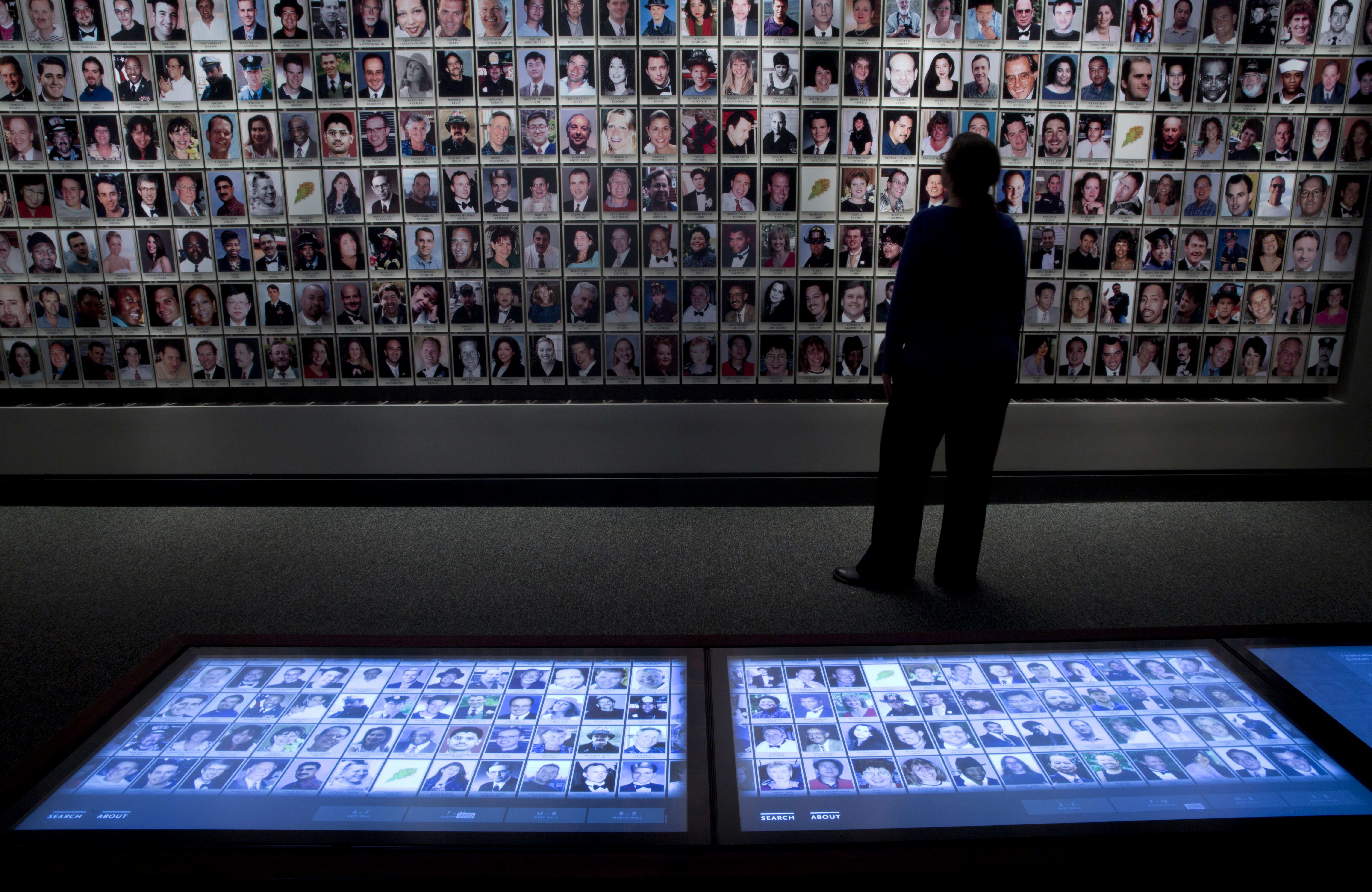
With my exhibit design studio I went to visit the 9/11 Memorial Museum earlier this fall to study different kinds of exhibition techniques. Despite the overwhelming amount of content and the obviously very somber and distressing subject of the exhibitions, one of the spaces at the museum that struck me the most was one of the most simply designed. Dubbed the Reflection Room, this space serves as both a memorial and an exhibition. The space honors the lives of the 2,983 victims by featuring photographs of those lost as well as some of their personal items and personal remembrances recorded by those closest to them.

911 rendering

A rendering of the Reflection Room (Image source)

From the museum’s website, “Visitors enter the exhibition along a corridor in which portrait photographs of the nearly 3,000 victims form a “Wall of Faces,” communicating the scale of human loss. Nearby, touchscreen tables allow visitors to discover additional information about each person, including photographs, images of objects, and audio remembrances by family, friends, and coworkers. An inner chamber presents profiles of individual victims in a dignified sequence through photographs, biographical information and audio recordings.”

911 wall & kiosk

The wall of portraits and the touchscreen kiosks that were searchable by name or photo (Image source)

Interestingly, some of the most important digital tools in this exhibit are ones that is not visually obvious to museum visitors. These are the methods that the museum uses to collect the audio recordings. In our class we haven’t spent a lot of time discussing digital tools that relate specifically to audio, but they were such a meaningful part of this museum that I thought it would be interesting to look into some of the recording techniques a bit more closely.

After researching I found that museum visitors can record their own stories via three different methods: while visiting the museum they can record in the recording booths on site; offsite they can participate in the Call to Remember Archive by calling a toll free number and recording a 10 minute long remembrance over the phone; or they can record at any location of the StoryCorps recording booths (currently in Atlanta, Chicago, and San Francisco), or at one of StoryCorps’ mobile booths, as part of the StoryCorps September 11th Initiative. Many of the recordings are archived at this website, so that friends and family may listen to the remembrances outside of visiting the memorial exhibit.

911 oral remembrances kiosk

On-Site recording booth (Image source)

I really found the audio recordings to be one of the most powerful digital tools at this museum. The amount of audio content on display is vast: they include day-of recordings from victims, first responders, media, and  survivors; memories from Lower Manhattan residents and and recovery workers; and finally the above remembrances made by friends and family members. All of these different recorded perspectives are pieces of the 9/11 Memorial Museums Oral Histories collection.

Sound is a very evocative tool for museums: listening to spoken word is much more personal than reading the same content. Also, memories woven together can create a very strong narrative. While in a museum of this subject it easy to understand why audio recordings would be such a powerful digital tool, I think other kinds of museums should experiment with integrating personal audio recordings into their exhibits as well. I can see this becoming particularly compelling with history museums where oral histories can become more prominent parts of the collection or contemporary art museums where the artists are still living and can personally describe their work.